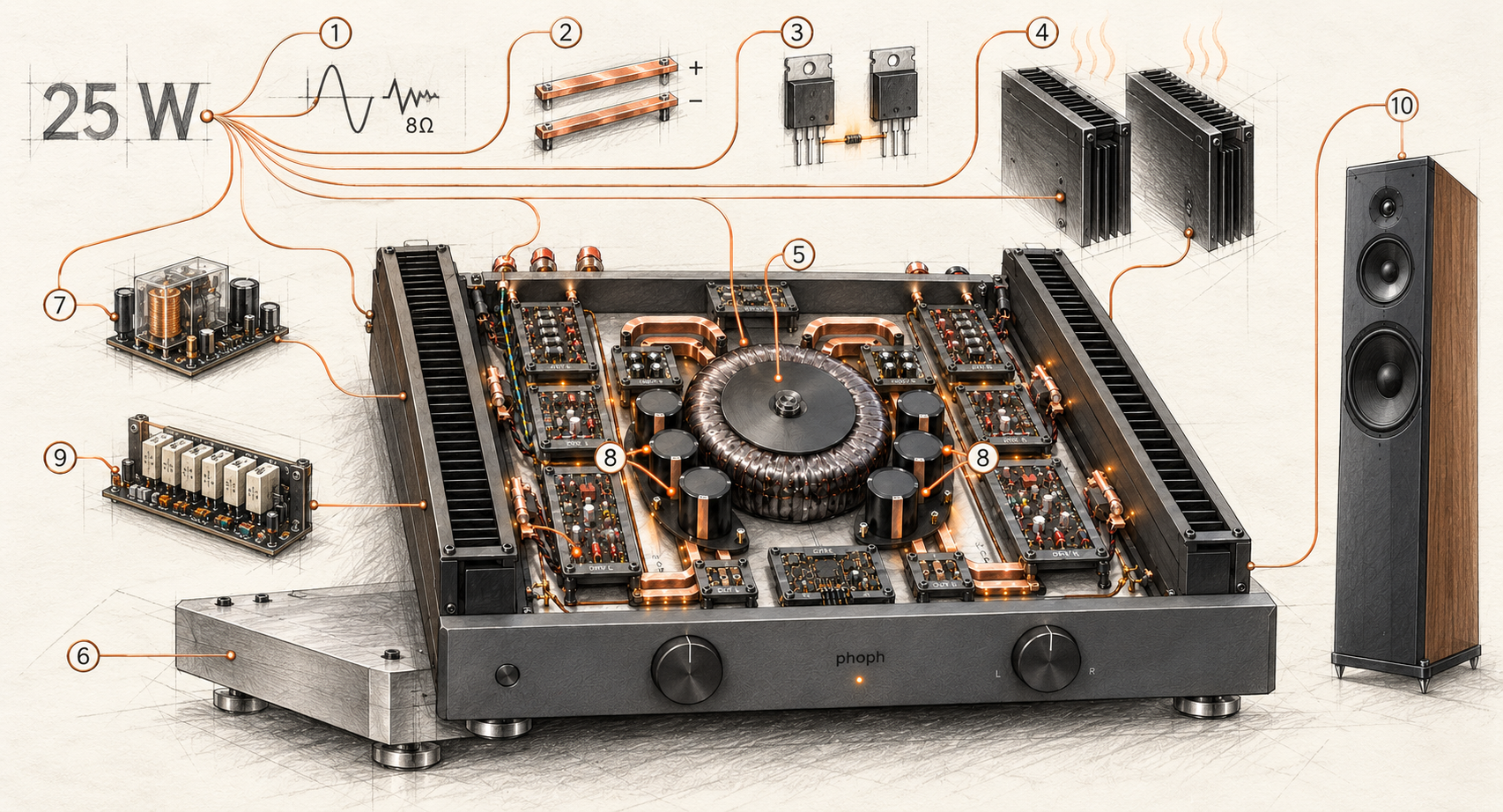
It started with a number: 25 Watt. In the Watt spectrum, twenty-five is early. It’s for starters but that number has consequences. Ten to be precise, ten design decisions suggested by a single number, and every main part of this machine is one of them.
- The first consequence is voltage. Power into a load is voltage squared over resistance, so 25 W into 8 Ω is 14.14 V RMS, 20 V peak and 2.5 A peak. Small numbers, and 8 Ω is a large resistance next to what a loudspeaker asks for.
- The second is the rails. The supply has to sit above that 20 V peak, with room for the output devices and for the sag when the music asks for current. That’s where ±29 V comes from. Not a preference. Not what happened to be in the parts drawer.
- The third is the bias, the first few Watts. It’s the only place in this machine where a preference gets a vote. Half an amp of quiescent current through the output stage buys about 4 W of class A operation into 8 Ω.
- The fourth consequence is heat. Half an amp through the output stage dissipates roughly 27 W per channel at idle, that prescribes heatsinks. It’s the bill for class A.
- The fifth is the supply. A two channel 25 W amplifier needs roughly 120 to 160 VA of transformer. This one has 300 VA, roughly twice what the output stage can ask for, so the rails don’t move when the music stops being polite.
- The sixth is size and weight. It starts with a 300 VA toroid that drives depth of the chassis, the thickness of the base plate and by the time you’ve worked through the construction of the amplifier, you end up with roughly nine kilograms.
- The seventh is the inrush board. 300 VA switched into empty reservoirs looks like a short circuit to the mains for a fraction of a second. The soft-start board exists because of a decision about transformer size.
- The eighth is the reservoir. Eight 10,000 µF capacitors, sized by the rails and by the current the load draws.
- The ninth is the attenuation and gain. A six-bit relay-switched 10 kΩ attenuator ladder, and a gain arranged so that an ordinary 2 V source reaches full output, i.e. a gain 7 in total.
- And the tenth consequence is outside the box. Twenty-five watts also says which loudspeakers belong with it. That’s a consequence like the others.
That’s what 25 Watts implies. Nine consequences inside the box, and the tenth standing on the floor at the end of the speaker cable.
Leave a Reply