This blog is a story of amplifiers, but it is also a story of a lifelong passion for electronics. From a 5 year old kid listening to a crystal receiver, to an old man, the very same, looking back. Join me, and the bots on the bench, in living that story through the development and construction of a 25 W MOSFET amplifier.
That’s the plan. Before we start, let me tell you what this journal is not going to be, because there is an easier version of it. I could explain the amplifier. Start with the power supply, walk you through a long-tailed pair and a voltage amplifier stage and a bias spreader, end up with 25 W and a distortion figure, and a schematic. OK, I will do a bit of that but you’ll find better resources elsewhere.
So why this blog? Because I want to record how this one got built, and that starts nowhere near a workbench.
Let’s zap back to a kitchen at the end of the sixties. I was five, and I had a crystal receiver: a coil, a tuning capacitor, a germanium diode and one earpiece, built from a Philips kit. No battery anywhere in it. A wire out of the window, and whatever was already in the air.
Something in that small pile of parts pulled a human voice out of nothing, and I don’t think I have been more mesmerised by a machine since, and it’s not like I haven’t tried. I have spent a decade working around particle accelerators at CERN and if anything, I thought that was quite normal. Just another job. I’ve worked in air transport and although I feel a thrill to this day when a plane takes off, that first crystal set was pure magic.
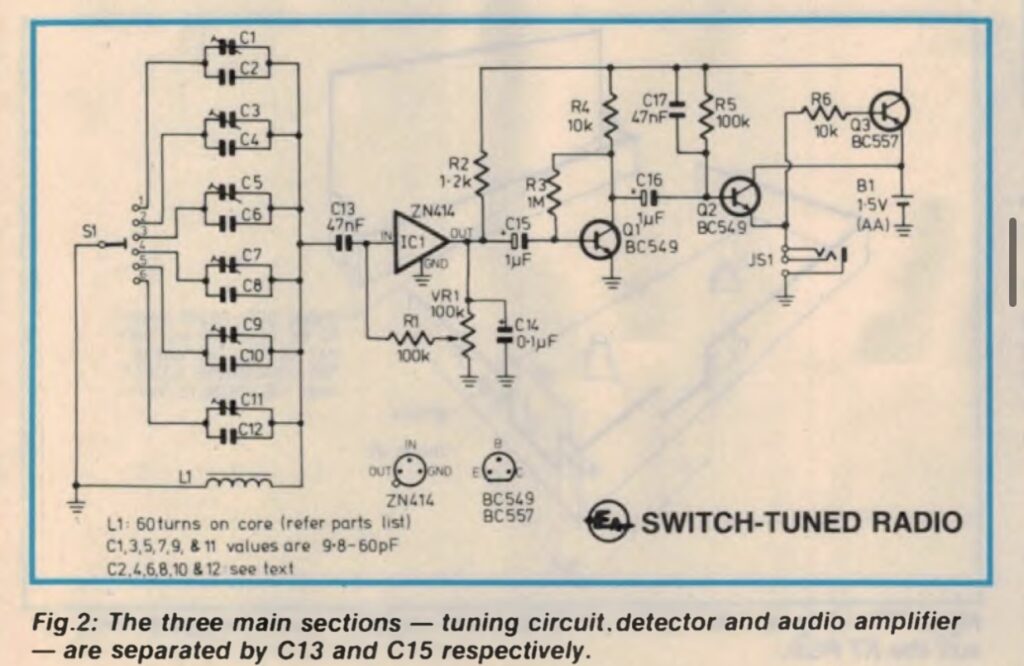
I worked for a couple of hobby magazines, designing and writing about electronic circuits. I made good on an unspoken promise to myself that I would once design my own radio receiver. That became the K7 receiver hobby project published in the September 1987 issue.
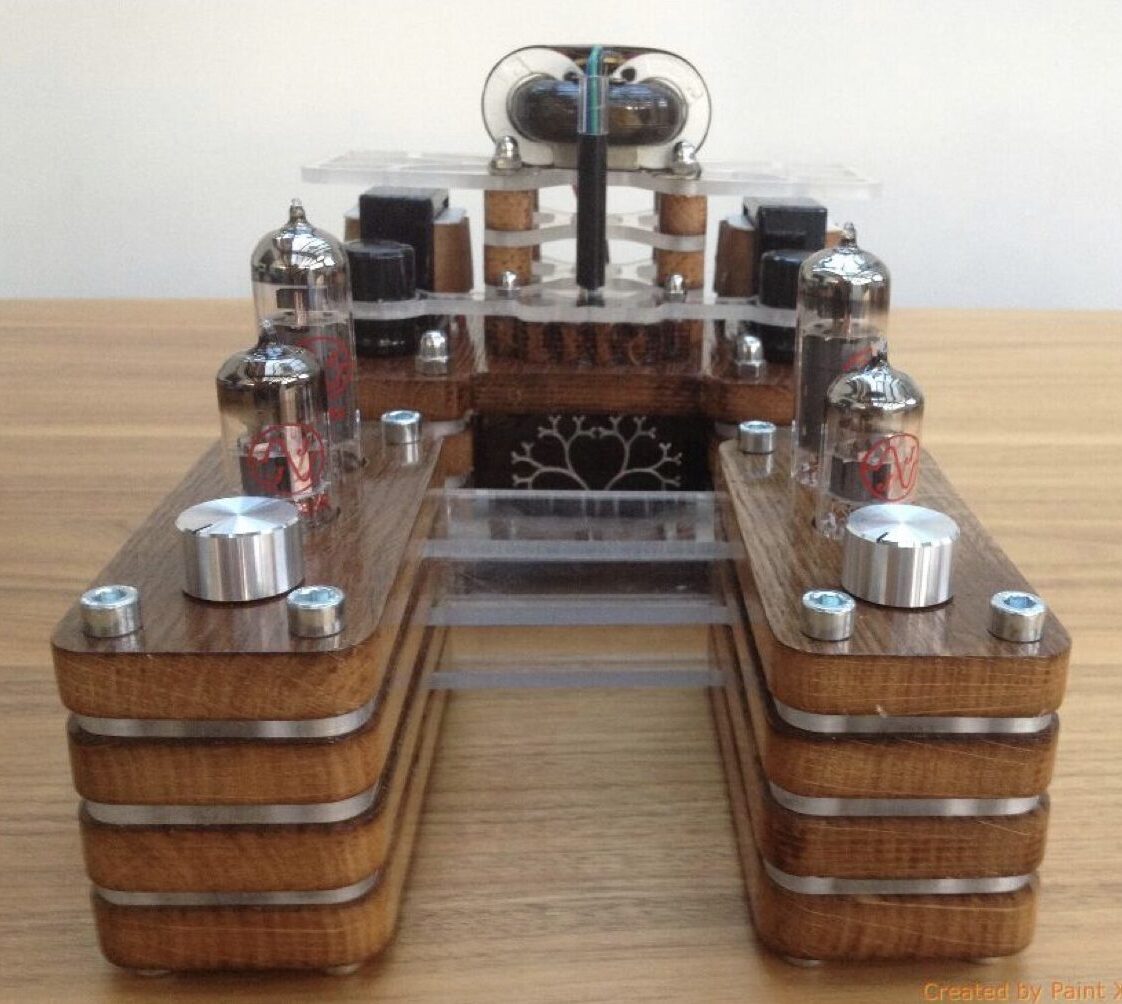
Somewhere on this journey I designed and built a tube amplifier as well. It was perhaps that effort that set me on this journey of “phoph amplifiers”, “technology made visible”. It already embodied the idea of using the components as elements of design architecture. I’m sure that this will come up more than a few times in this blog.
But this tube amp is a story for another time. Now I’ve started phoph amplifiers, celebrating my own half a century of interest in electronics. Applying the lessons I’ve learned, the ideas I’ve had, my own views. But more importantly, to learn an art that many have learned before me. The great engineers from the last century, the first century of electronics.
But enough talking, let’s get started. Below is a “bench sheet”, this is what I’m working on. It may evolve, of it may end up being exactly that. Let’s find out.
Bench sheet — Status: on the bench
| Object | Phoph-25 / Field, rev 03. Prototype, one channel built |
| Output | 25 W into 8 Ω, class AB; 0.50 A quiescent = 4 W in class A into 8 Ω |
| Supply | ±29 V from a single 300 VA toroid (Toroidy TTSA0300), 2 × 20 V secondary; one rectifier and reservoir per channel; 8 × 10,000 µF |
| Volume | 6-bit relay-switched attenuator, 10 kΩ, reed relays |
| Source | external Bluetooth receiver |
| Mechanism | 440 × 300 × 5 mm · 430 mm wide with the side heatsinks ·transparent window, no metal top. ≈9.2 kg estimated weight |
| Boards | 6 — inrush released, preamp closed, driver in placement, three to route |
Leave a Reply